

how many combinations with 10 binary options
Binary Digits
 | A Binary Digit can only be 0 or 1 |
In the reckoner world "binary diginformation technology" is often shortened to the discussion "fleck"
More than Than 1 Digit
So, in that location are only two ways we tin take a binary digit ( "0" and "1" , or "On" and "Off") ... only what nearly 2 or more binary digits?
Let'southward write them all down, starting with 1 digit (yous can test it yourself using the switches):
Hither is that last list sideways:
| 0000 | 0001 | 0010 | 0011 | 0100 | 0101 | 0110 | 0111 | k | 1001 | 1010 | 1011 | 1100 | 1101 | 1110 | 1111 |
And (without the leading 0s) we have the first xvi binary numbers:
| Binary: | 0 | ane | 10 | 11 | 100 | 101 | 110 | 111 | 1000 | 1001 | 1010 | 1011 | 1100 | 1101 | 1110 | 1111 |
|---|---|---|---|---|---|---|---|---|---|---|---|---|---|---|---|---|
| Decimal: | 0 | 1 | 2 | iii | four | 5 | 6 | 7 | 8 | 9 | 10 | 11 | 12 | thirteen | 14 | fifteen |
This is useful! To remember the sequence of binary numbers just recollect:
- "0" and "1" {0,i}
- then repeat "0" and "i" once again simply with a "i" in front: {0,one,10,11}
- then repeat those with a "1" in forepart: {0,1,10,eleven,100,101,110,111}
- and so on!
At each stage we repeat everything we have and so far, merely with a one in front.
Now find out how to use Binary to count past 1,000 on your fingers:
Binary Digits ... They Double!
As well notice that each time we add some other binary digit we double the possible values.
Why double ? Because we take all the previous possible values and match them with a "0" and a "1" like in a higher place.
- So simply 1 binary digit has 2 possible values (0 and 1)
- Ii binary digits have 4 possible values (0, 1, 10, 11)
- Three have 8 possible values
- Four take 16 possible values
- Five have 32 possible values
- Six have 64 possible values
- etc.
Using exponents, this can be shown as:
| Number of Digits | Formula | Settings |
|---|---|---|
| 1 | 21 | 2 |
| 2 | 2two | four |
| three | iithree | 8 |
| 4 | 24 | 16 |
| v | 25 | 32 |
| 6 | 26 | 64 |
| etc... | etc... | etc... |
Example: when we have l binary digits (or fifty things that can merely have two positions each), how many unlike means is that?
Answer: 2fifty = 2 × 2 × 2 × two × 2 ... (fifty of these)
= 1,125,899,906,842,624
And so, a binary number with 50 digits could have one,125,899,906,842,624 dissimilar values.
Or to put it another way, it could show a number upward to i,125,899,906,842,623 (notation: this is ane less than the total number of values, because one of the values is 0).
Instance: Kickoff the month with $1 and double it every day, later 30 days you will be a billionaire!
twoxxx = 2 × 2 × two × two ... (thirty of these)
= 1,073,741,824
Chess Board
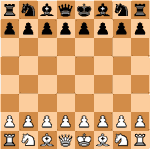
In that location is an old Indian legend about a King who was challenged to a game of chess past a visiting Sage. The Male monarch asked "what is the prize if y'all win?".
The Sage said he would but like some grains of rice: ane on the first square, 2 on the 2d, iv on the third and so on, doubling on each square. The King was surprised by this humble request.
Well, the Sage won, so how many grains of rice should he receive?
On the first square: 1 grain, on the second square: ii grains (for a total of 3) and so on like this:
| Square | Grains | Full |
|---|---|---|
| 1 | ane | 1 |
| 2 | two | 3 |
| three | 4 | 7 |
| 4 | viii | 15 |
| 10 | 512 | 1,027 |
| 20 | 524,288 | i,048,575 |
| thirty | 53,6870,912 | one,073,741,823 |
| 64 | ??? | ??? |
Past the 30th square yous can encounter it is already a lot of rice! A billion grains of rice is near 25 tonnes (i,000 grains is about 25g ... I weighed some!)
Notice that the Total of any square is 1 less than the Grains on the side by side square (Example: square 3's full is 7, and square iv has viii grains). And then the full of all squares is a formula: iinorthward−1, where northward is the number of the square. For example, for square 3, the total is ii3−ane = 8−one = 7
And so, to fill up all 64 squares in a chess board would demand:
264−ane = 18,446,744,073,709,551,615 grains (460 billion tonnes of rice),
many times more than rice than in the whole kingdom.
So, the power of binary doubling is zero to be taken lightly (460 billion tonnes is not light!)
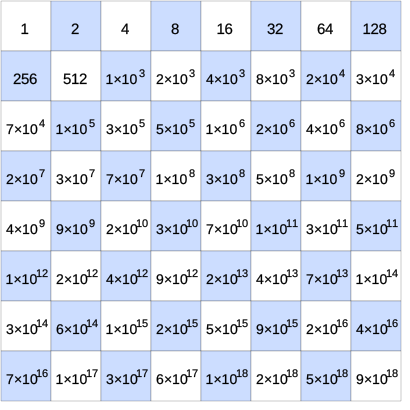
Grains of rice on each foursquare using scientific note
Values are rounded off, so 53,6870,912 is shown equally just five×ten8
which means a v followed by viii zeros
(By the way, in the legend the Sage reveals himself to be Lord Krishna and tells the Rex that he doesn't have to pay the debt at once, just tin can pay him over time, just serve rice to pilgrims every day until the debt is paid off.)
Hexadecimal
Lastly, permit us look at the special human relationship between Binary and Hexadecimal.
There are 16 Hexadecimal digits, and we already know that 4 binary digits accept 16 possible values. Well, this is exactly how they chronicle to each other:
| Binary: | 0 | 1 | 10 | 11 | 100 | 101 | 110 | 111 | 1000 | 1001 | 1010 | 1011 | 1100 | 1101 | 1110 | 1111 |
|---|---|---|---|---|---|---|---|---|---|---|---|---|---|---|---|---|
| Hexadecimal: | 0 | 1 | 2 | 3 | 4 | 5 | 6 | vii | 8 | ix | A | B | C | D | Due east | F |
So, when people use computers (which prefer binary numbers), it is a lot easier to use the single hexadecimal digit rather than 4 binary digits.
For case, the binary number "100110110100" is "9B4" in hexadecimal. I know which I would adopt to write!

Source: https://www.mathsisfun.com/binary-digits.html
Posted by: smithairsed.blogspot.com
0 Response to "how many combinations with 10 binary options"
Post a Comment